
Explore some of my most recent projects. Each garden tells a unique story, the fruit of passion, collaboration, and expertise. From design to completion, I oversee every stage with precision and attention to detail.

Recent works

Panzano in Chianti

Panzano in Chianti

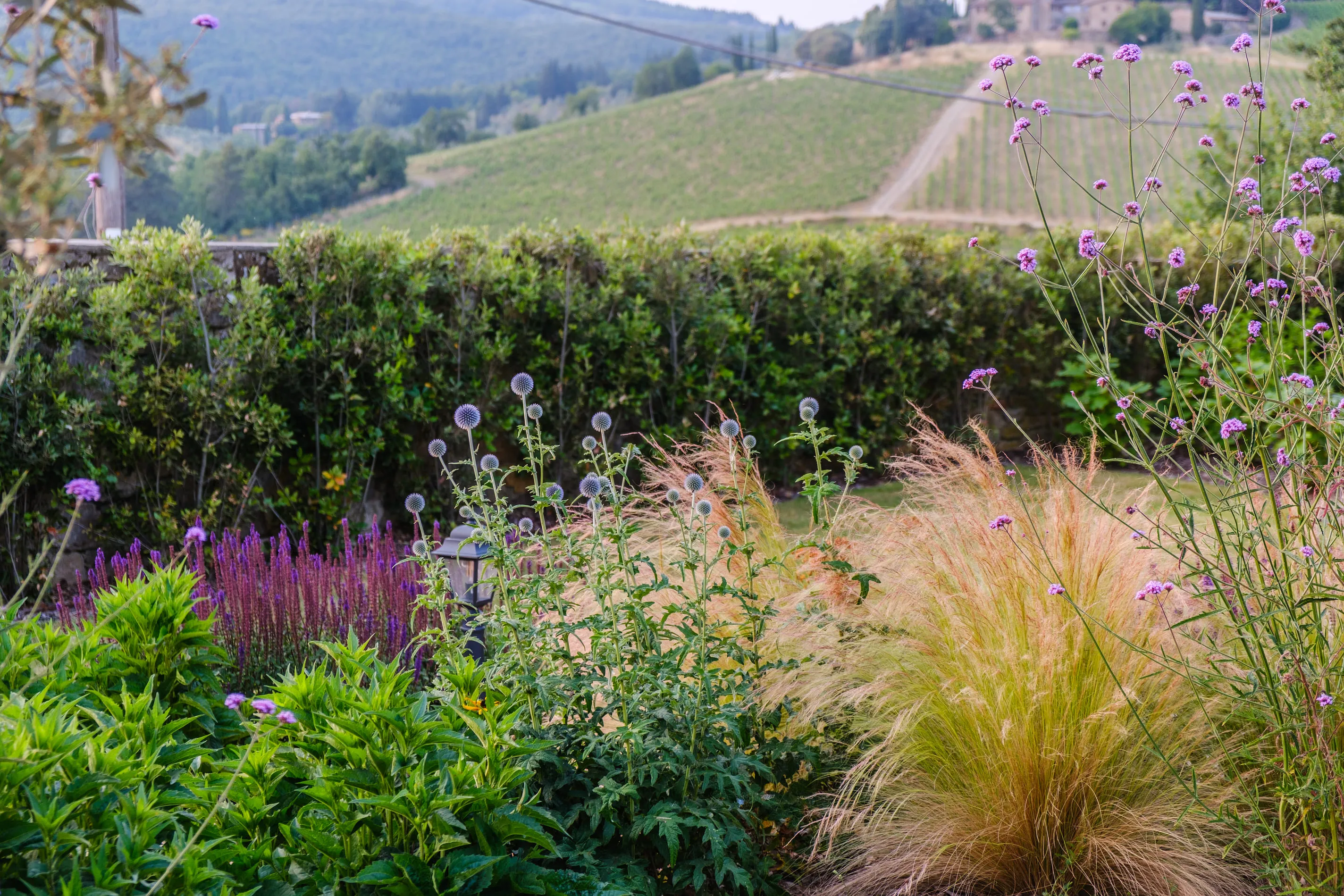
Nestled among the vineyards of Chianti Classico, this garden of approximately 3,000 square metres was born from the owners' desire to have an outdoor space rich in flowers, creating a unique environment that would give them a magical atmosphere during their one month stay in Italy, returning from their hectic life in London.

This area of Tuscany is characterised by dry, arid summers and low water availability. The landscape designer's goal was clear: to create a garden with low water requirements and low maintenance. The key was to reduce the lawn area as much as possible, using a much more resistant variety than the classic Festuca, with significantly lower water requirements, and enhancing the setting with borders rich in perennial herbaceous plants and grasses in the areas of the garden adjacent to the house and swimming pool, so as to have an explosion of colour during the period when the owners are present.

In the perimeter areas, in order to provide permanent coverage throughout the year, mainly evergreen Mediterranean plants were used to create a true Mediterranean scrub, i.e. a hedge that is different from the classic single-variety, regular-shaped hedge, but rich in species, with touches of colour provided by rockroses, broom and buddleia and movement provided by grasses.

View Project
Loro Ciuffenna

Loro Ciuffenna

We are located in the hills surrounding the small village of Loro Ciuffenna, in the province of Arezzo. This project stems from the client's need for a garden that can be enjoyed all year round, is low maintenance and features plants with reduced water requirements, given the limited availability of water. The project began with the addition of an “Olea europea” olive tree, so as to avoid a sharp difference in height between the large retaining wall and the plants in the borders below, creating harmony with the surrounding land, which is rich in olive groves.

The basic rule for creating a true dry garden is to plant in autumn, so that the plants can absorb as much water as possible during the rainy season and develop deep root systems. This will allow us, once summer arrives, to have plants that can withstand periods of drought, watering less frequently but more abundantly.

The choice of plants was fundamental to the success of this project. Mainly, spheres of different sizes were used, consisting of evergreen Mediterranean shrubs, so as to ensure a filling effect throughout the year. Immersed in this evergreen matrix, we find mainly perennial herbaceous plants and grasses, capable of harmoniously linking the garden with the surrounding countryside.

View Project
Montelupo Fiorentino

Montelupo Fiorentino

The concept of a dry garden is not always tied to old farmhouses or rural landscapes. On the contrary, it can coexist perfectly with modern architecture and more urban settings. In fact, it is precisely in these environments that plant communities stand out most vividly, creating almost surreal atmospheres, a balance between spontaneity and structure, between nature and contemporary design.
In this case, a rigid, geometric architectural structure required a garden with soft, fluid lines, one capable of lightening the volumes and serving as a transition between the building and the surrounding natural landscape, despite the site’s proximity to the city. As in many of my projects, the main challenge was water scarcity, a recurring theme that guides every design decision toward the use of drought-tolerant, low-maintenance plants.
This garden is a concrete example of that approach. Despite initial complications due to poorly executed earthworks (carried out by external contractors), slopes that directed water toward the building, and unsuitable fill soil, it was possible to restore ideal conditions thanks to the collaboration with skilled professionals aware of the risks inherent in seemingly “cost-saving” solutions.
Several days of work were required to reestablish proper grading, improve soil structure with the addition of sand, and bring the natural, free-draining topsoil back to the surface. Only then could the true construction of the garden begin, shaping the soft contours that define the transitions between lawn and planting areas.
Plant selection played a fundamental role: the goal was to create a visual and sensory connection with the surrounding landscape, as if the garden were a natural extension of it. Ornamental grasses became the main design matrix, dynamic, airy plants that change color with the seasons and provide a sense of fullness without heaviness. Alongside them, perennials such as Aster and Veronicastrum add touches of exuberance, alternating with species whose blooms are more discreet yet always engaging throughout the year. It was essential to design a garden that remains alive and expressive in every season, since the owners experience it daily.
In summary, this project demonstrates that the dry garden is not bound to a single context or architectural style, but represents a versatile and sustainable design philosophy, one that can adapt to and enhance a wide variety of environments.

View Project
Villa Oliveto Castelmuzio

Villa Oliveto Castelmuzio

We are in the heart of Tuscany, in one of the region’s most iconic areas: the Val d’Orcia, a land of wide horizons, cypress-lined roads, and extraordinary natural scenery.
The clients, initially unaware of the site’s full potential, gave me great creative freedom, allowing me to fully express my vision as a landscape designer.
Creating a low-water garden in a context where water is a limited resource is not only a necessity but also a great challenge. The soils in this area (heavy, clayey, and tuffaceous) did not allow for radical interventions such as removing 30-40 cm of topsoil and replacing it with a new substrate, due to the high costs involved.
Collaboration with an experienced gardener therefore proved essential. His deep tilling work, carried out in several passes, improved the soil structure, lightening it with sand and enriching it with a fraction of compost. Creating a substrate suitable for the healthy development of plant communities is more than half the work: even the most refined design loses its value if the soil is not properly prepared.
The project draws inspiration from the spontaneous landscapes of the Val d’Orcia and the pioneer vegetation that inhabits them. Since the garden belongs to a boutique hotel dedicated to weddings and events, it was also necessary to include large lawn areas, balancing aesthetic and functional needs with the dry garden philosophy.
A dry garden is a self-sufficient ecosystem, based on draining and porous substrates, gravel-mulched surfaces, and Mediterranean plants resistant to drought and extreme climatic conditions. In this case, while it was not possible to create a “pure” dry garden, irrigation was reduced through the use of drought-tolerant lawn varieties, and maintenance was automated with robotic mowers.
The planting composition is based on an evergreen matrix of Mediterranean shrubs, such as Cistus and Pistacia lentiscus, enriched with ornamental grasses (Stipa, Pennisetum) that bring naturalness and movement. From this base emerge delicate, non-invasive blooms that offer soft touches of color from spring to late autumn, maintaining a continuous balance between beauty and sustainability.

View Project